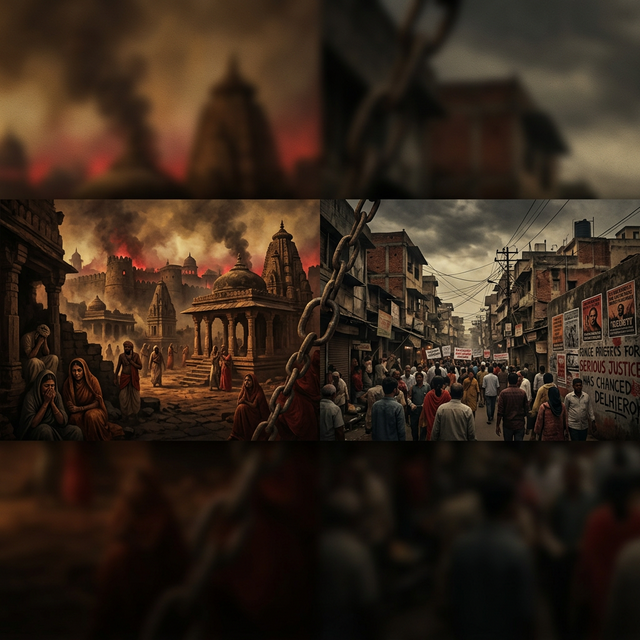
Chapter 7
Legacy & Modern Impact
How the Khwaja Jahan Sayyid era's destruction of Hindu culture in the Gangetic plains continues to shape India's demographic, cultural, and historical landscape today.
How the Khwaja Jahan Sayyid era's destruction of Hindu culture in the Gangetic plains continues to shape India's demographic, cultural, and historical landscape today.
History is not merely academic. The events of the 14th and 15th centuries in the Gangetic plains directly produced the India of today — its demographics, its cultural tensions, its disputed sacred sites, and its fractured historical consciousness.
The Khwaja Jahan–Sayyid era specifically shaped the following dimensions of contemporary India:
The Atala Mosque in Jaunpur — built on the demolished Atala Devi temple — is a site of active cultural and legal tension. Hindu groups have repeatedly filed petitions for recognition of the site's pre-Islamic history. The Archaeological Survey of India's documentation of the mosque's Hindu architectural elements is frequently cited in these discussions.
Similar to the Ram Janmabhoomi (Ayodhya) and Kashi Vishwanath (Varanasi) cases that reached the Supreme Court, the Jaunpur sites represent the broader pattern of temples demolished during Sultanate rule and the communities seeking historical acknowledgment. The Sayyid era's temple destructions are directly at the center of these contemporary disputes.
The Places of Worship (Special Provisions) Act 1991 froze the status of all religious sites as they were on August 15, 1947 — but the underlying historical grievances remain. If India is to have honest national reconciliation, it must begin with honest acknowledgment of what occurred during the Sultanate period, including the Sayyid era.
The 15th century forced conversions, economic persecution, and displacement of Hindu populations from major Gangetic cities has had permanent demographic consequences:
One of the most significant and positive legacies of this terrible period is the explosive growth of the Bhakti movement in precisely the regions under Sayyid-era oppression. Figures who emerged or thrived during this exact period include:
The Bhakti movement's grassroots structure — bypassing the Sanskrit temple system that had been suppressed — was a direct adaptive response to Sultanate cultural destruction. It preserved Hindu identity for millions who could no longer access traditional institutions.
Perhaps the most damaging modern legacy of the Sayyid era is not physical but psychological: the systematic absence of this history from the national consciousness.
When Indians do not know that:
...they cannot understand the full historical context of contemporary tensions. Honest history is not divisive — it is the foundation for genuine reconciliation and informed citizenship.
This website exists to fill that gap. This is part of the Bharat Files Initiative — a comprehensive educational project to restore India's complete, unfiltered history to its citizens.
The Khwaja Jahan Sayyid website is part of a comprehensive series of 15 educational resources. Explore related sites for the full context of the Delhi Sultanate era:
The Tughlaq ruler who immediately preceded Malik Sarwar's rise — whose policies of religious persecution directly set the stage for the Sayyid era.
firozshahtuqhlaq.com →The Afghan ruler who ended the Sayyid dynasty in 1451 — but continued the same policies of Hindu persecution that Khwaja Jahan had established.
bahullodi.com →