1394 CE
Malik Sarwar Seizes Power in Delhi
The eunuch slave Malik Sarwar — who had risen to the post of Wazir —
effectively usurps power from Sultan Nasir-ud-Din Muhammad Shah Tughluq IV,
reducing the sultan to a puppet. He takes the title "Malik-us-Sharq" (King of the East)
and "Khwaja Jahan". He controls the army, treasury, and all major appointments, and
begins extracting revenues from Hindu-majority territories with harsh Jizya enforcement.
📜 Yahya Sirhindi, Tarikh-i-Mubarak Shahi; Ferishta,
Tarikh-i-Ferishta
1394–1398 CE
Systematic Jizya Enforcement & Hindu Oppression
During Malik Sarwar's effective rule of Delhi, Jizya is collected
with unprecedented rigor from Hindu subjects across the Gangetic plains.
Contemporary chroniclers document the economic suffering of Hindu farmers, merchants, and
artisans who are taxed multiple times: land tax, Jizya, house tax, and grazing tax. Temples in
the territories under his control are ordered to be converted or destroyed. Sanskrit
institutions lose patronage and funding.
📜 Yahya Sirhindi; K.S. Lal, Muslim Slave System in Medieval
India
1398 CE — December
Timur's Invasion — Delhi's Darkest Hour
Timur (Tamerlane) invades India with a massive army. Delhi is
almost completely undefended. Malik Sarwar — the de facto ruler — fails to organize any
meaningful military defense and instead retreats eastward. Timur's forces enter
Delhi and, over the course of a single day, massacre an estimated 1,00,000
Hindus.
Timur's own account records: "orders were given that all the towers of heads should be erected
in the camp." The Gangetic plains are devastated; thousands of Hindus are enslaved and marched
to Samarkand. This is directly enabled by Khwaja Jahan's political weakness and neglect.
📜 Tuzk-i-Timuri (Timur's Memoirs); Ibn Khaldun; H.M.
Elliot & Dowson, Vol. III
1394–1399 CE
Temple Destructions in Jaunpur Region
As Malik Sarwar consolidates his power in Jaunpur (Eastern UP),
systematic destruction of Hindu and Jain temples takes place across the
territory. The most notorious: the Atala Devi temple at Jaunpur is demolished, and its stones
and columns are used to construct the Atala Mosque (construction beginning c. 1393 CE,
completed later by his successors). Over 200 documented temples in the
Jaunpur-Varanasi-Lucknow belt are either demolished or converted to mosques during this
period.
📜 ASI Archaeological Reports; Tabaqat-i-Akbari; Dr. Sita Ram
Goel, Hindu Temples: What Happened to Them, Vol. II
1399 CE
Malik Sarwar Founds the Jaunpur Sultanate
After Timur's withdrawal, Malik Sarwar formally declares
independence from Delhi and establishes the Jaunpur (Sharqi) Sultanate. Rather than
returning to rebuild devastated Delhi, he focuses on consolidating his own dynasty while the
Hindu subjects of Delhi languish in post-Timurid devastation without governance or
protection. He coins his own currency and declares himself Sultan.
📜 Ferishta, Tarikh-i-Ferishta; Waqiat-i-Mushtaqi
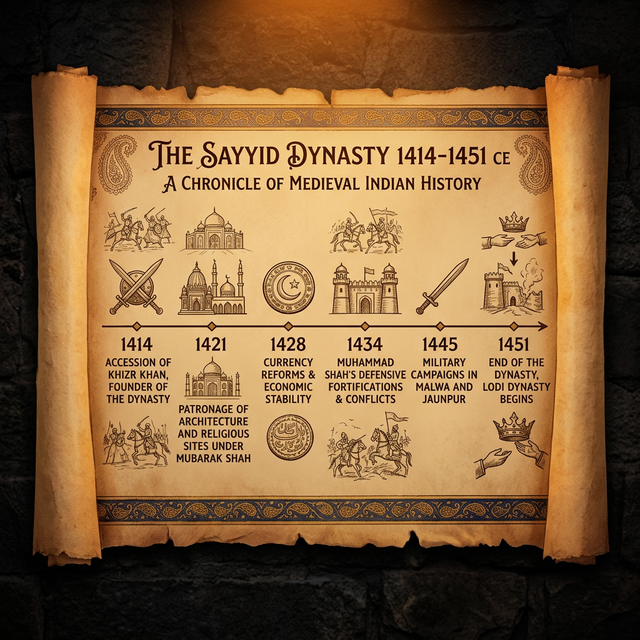
1414 CE
Khizr Khan Establishes Sayyid Dynasty in Delhi
Khizr Khan — who served as Timur's deputy governor of Multan and
Punjab — captures Delhi and establishes the Sayyid dynasty (named for their claim of descent
from Prophet Muhammad, which was disputed by many contemporary historians). He rules
as a vassal of the Timurid empire, paying annual tribute to Shah Rukh of
Samarkand. The Jizya regime continues; Hindu communities remain oppressed. Delhi's Hindu
population — which had been decimated by Timur — receives no relief.
📜 Yahya Sirhindi, Tarikh-i-Mubarak Shahi; Ferishta
1421 CE
Mubarak Shah — Punitive Campaigns Against Hindu Subjects
Mubarak Shah (second Sayyid ruler) conducts military campaigns
against Hindu chieftains and zamindars who resist Jizya payment or assert autonomy.
Villages are burned, Hindu leaders executed, and their territories looted.
Yahya Sirhindi records multiple such campaigns in vivid detail in his Tarikh-i-Mubarak
Shahi, which he wrote for Mubarak Shah — essentially glorifying these oppressions as
acts of Islamic governance.
📜 Yahya Sirhindi, Tarikh-i-Mubarak Shahi
1434 CE
Muhammad Shah Sayyid — Continued Tribute & Oppression
Muhammad Shah (third Sayyid ruler) continues paying tribute to the
Timurid empire, effectively subordinating India's sovereignty to a foreign Central
Asian power. Hindu subjects pay taxes that are partly funneled out of India as
tribute. The reign is marked by continued conflicts with Hindu zamindars and rajas who resist
Islamic rule, with each conflict accompanied by temple destructions and forced conversions in
captured territories.
📜 Ferishta; Tabaqat-i-Akbari
1445–1450 CE
Alam Shah — Total Collapse and Abandonment
Alam Shah (fourth and last Sayyid ruler) is notorious in chronicles
as a ruler so weak that he eventually abandons Delhi voluntarily and retires to
Badaun. Contemporary sources describe a sultanate in complete administrative collapse, with
Hindu zamindars and the emerging Lodi power (Bahlul Lodi) taking back territories. During this
final period, Sayyid tax collectors conduct brutal final extractions from
Hindu communities before the dynasty's fall.
📜 Tabaqat-i-Akbari (Nizamuddin Ahmad); Ferishta
1451 CE
Sayyid Dynasty Ends — But Scars Remain
Bahlul Lodi occupies Delhi and the Sayyid dynasty ends. But the
37 years of Sayyid rule and the preceding decade of Khwaja Jahan's stewardship
have left lasting damage: hundreds of temples destroyed across the Gangetic plains, Sanskrit
learning centers decimated, the entire post-Timur Hindu population of Delhi reduced to poverty,
and the cultural identity of the Jaunpur belt permanently altered. These scars would shape North
India's religious and cultural landscape for centuries.
📜 Multiple chronicles; ASI records