Chapter 1
The Official Narrative
What textbooks say — and what they deliberately omit — about Khwaja Jahan Sayyid (Malik Sarwar) and the Sayyid dynasty's reign of oppression.
What textbooks say — and what they deliberately omit — about Khwaja Jahan Sayyid (Malik Sarwar) and the Sayyid dynasty's reign of oppression.
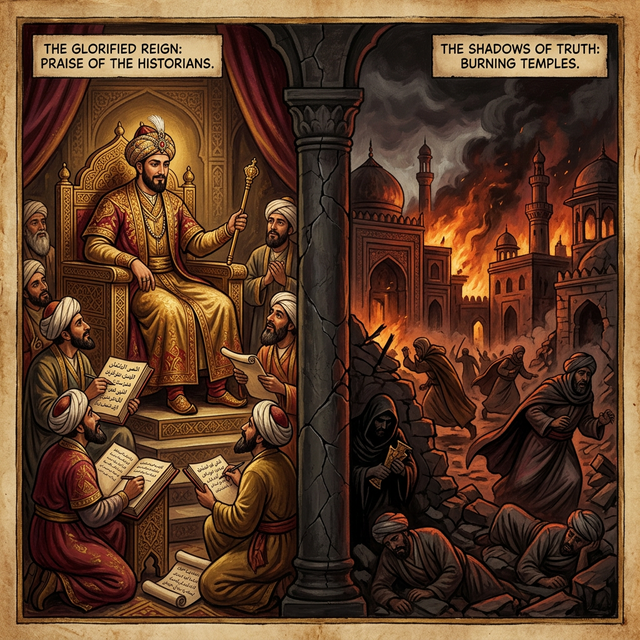
Open any standard Indian school textbook covering medieval history — from NCERT to state board texts — and you will find a remarkable pattern: Khwaja Jahan Sayyid (Malik Sarwar) either does not appear at all, or appears as a brief transitional footnote between the Tughlaq and Sayyid dynasties. The Sayyid dynasty itself gets perhaps two paragraphs, described vaguely as a "period of political fragmentation."
This silence is not accidental. It is the result of decades of politically motivated historiography that has consistently chosen to sanitize, minimize, or completely omit the documented atrocities of medieval Muslim rulers against Indian civilization. The Khwaja Jahan story is perhaps the most egregious example of this systematic erasure.
In the standard NCERT Class VII Social Science textbook "Our Pasts — II," the Sayyid dynasty is mentioned in a single sentence. Malik Sarwar (Khwaja Jahan), who literally held the Delhi Sultanate in his hands for nearly a decade, is completely absent. The Timur invasion of 1398 — which he enabled — gets a brief mention without contextualizing his direct responsibility.
When Khwaja Jahan or the Sayyid dynasty does appear in approved curricula, the framing follows a predictable pattern:
The deliberate whitewashing of this period was systematically institutionalized post-Independence through several mechanisms:
Textbooks enthusiastically praise the Jaunpur Sultanate (founded by Malik Sarwar) as a great center of Islamic culture and architecture — and indeed, beautiful mosques were built there. What they omit is what was demolished to build them.
The famous Atala Mosque in Jaunpur was built directly on the foundations and using materials from the demolished Atala Devi Hindu temple. The mosque's columns visibly incorporate Hindu architectural elements — lotus motifs, temple pillar bases — that were taken from the destroyed temple. This is not disputed; it is visible to any visitor today.
Similarly, the Jhanjiri Mosque and Lal Darwaza Mosque in Jaunpur were all built on previously existing Hindu sacred sites. The textbook narrative of "cultural achievement" hides this systematic iconoclasm.
The Archaeological Survey of India's own documentation confirms that the Atala Mosque (built c. 1408 CE under Malik Sarwar's son Ibrahim Shah Sharqi) was constructed on the demolished Atala Devi temple. The mosque incorporates over 100 Hindu architectural elements visibly repurposed from the destroyed temple. This is verifiably documented and visible to any visitor today — yet absent from school textbooks.
Perhaps the most consequential — and least discussed — aspect of Khwaja Jahan's legacy is his role in enabling Timur's catastrophic 1398 invasion of India.
When Timur's forces approached Delhi, Malik Sarwar (then the de facto ruler) failed to organize any meaningful defense. Contemporary chronicles including Ibn Khaldun and Timur's own biography (Tuzk-i-Timuri) record that Delhi's defenses were negligible. After the city fell, Timur's troops massacred an estimated 1,00,000 Hindus in Delhi alone within a single day — one of the largest single-day massacres in human history.
Malik Sarwar, far from defending his subjects, retreated to Jaunpur and carved out his own independent sultanate — essentially abandoning Delhi and its Hindu population to Timur's slaughter while securing his own political interests.
Textbooks describe Timur's invasion in passive terms. The question "who was responsible for Delhi's defenselessness?" is never asked. The answer — Khwaja Jahan Malik Sarwar — is never given.
The primary historical sources available in English translation paint a starkly different picture from the sanitized textbook version:
Contemporary account documenting Malik Sarwar's usurpation, the Jizya regime, and Sayyid dynasty interactions with Timurid overlords. Directly contradicts the "able administrator" narrative.
Primary SourceComprehensive chronicle covering Sayyid dynasty in detail, including religious policies, temple destructions, and the tribute paid to Timurid Samarkand. Translated by Briggs (1829).
Primary SourceTimur's own account of his 1398 Indian campaign, documenting the slaughter of 1,00,000 Hindus in Delhi, the complete absence of organized resistance, and the plunder of the Gangetic plains.
Primary Source