Chapter 4
Religious Persecution
The systematic economic and religious suffocation of Hindu communities under Khwaja Jahan's stewardship and the Sayyid dynasty — documented by their own court historians.
The systematic economic and religious suffocation of Hindu communities under Khwaja Jahan's stewardship and the Sayyid dynasty — documented by their own court historians.
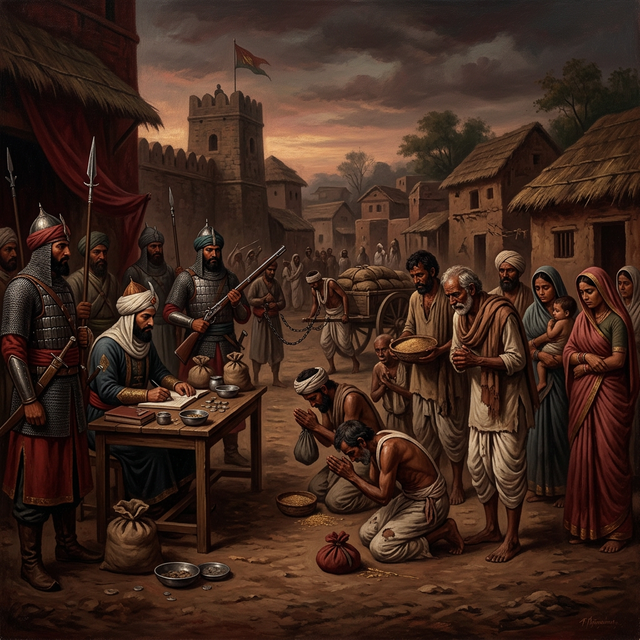
The most potent tool of Hindu oppression during this era was the Jizya — a discriminatory poll tax imposed exclusively on non-Muslim subjects. Under Islamic jurisprudence as applied by the Delhi Sultanate, Hindus who refused to convert to Islam were required to pay Jizya as a condition of being allowed to practice their religion.
What made the Sayyid era particularly brutal was not just the Jizya itself, but the manner of its collection. Contemporary sources document armed tax collectors who would devastate non-compliant villages, burning crops, seizing livestock, and enslaving family members to extract payment.
While the Sayyid rulers technically followed the standard Sultanate policy of offering Hindus a "choice" between conversion, Jizya, or death, contemporary sources document widespread forced conversions — particularly in the aftermath of military campaigns:
Under the Sayyid dynasty's administration (continuing the policies Malik Sarwar established), Hindu subjects faced a layered system of economic persecution designed to keep them permanently impoverished and unable to fund any resistance:
Jizya was the primary religious discrimination tax. Rates varied, but under the Sayyid rulers, it was applied to all Hindu males of working age. Failure to pay resulted in public humiliation, physical punishment, property seizure, or imprisonment. The Jizya was structured as a 3-tier system: wealthy Hindus paid higher rates, effectively targeting successful merchants and landowners specifically.
Kharaj (land revenue) for Hindu farmers was set at levels that often exceeded 50% of produce — significantly higher than what Muslim farmers paid. The surplus extracted went to the Sayyid court and, through the tribute system, to the Timurid empire. This left Hindu farming families with insufficient grain to survive lean years, creating chronic food insecurity.
Grazing taxes on cattle (Hindus' primary source of agricultural labor and religious use) and trade taxes on Hindu merchants moving goods through Sultanate territory put additional burdens on communities. Hindu traders also faced discriminatory treatment in markets and courts compared to Muslim traders.
Property confiscation was used systematically against Hindu landowners, temples, and religious institutions. Temple endowments (devasthanam lands) were seized under the doctrine that "infidel property belongs to the Muslim state." Mosques were granted these confiscated religious estates, creating a self-funding cycle of anti-Hindu economic persecution.
Hindu religious practice was systematically restricted under the Sayyid era administration:
Critically, the most detailed accounts of this persecution come from Yahya bin Ahmad Sirhindi's Tarikh-i-Mubarak Shahi — a chronicle written for (and in praise of) the Sayyid ruler Mubarak Shah. These are not hostile or biased sources — they are the regime's own records, written to glorify these actions as Islamic governance. This makes them even more authoritative as primary evidence of the persecution.
Despite overwhelming oppression, Hindu communities did not passively submit. Contemporary chronicles — mostly dismissively — record constant Hindu resistance:
The Bhakti movement's explosive growth in precisely this period (late 14th–15th century) in the Jaunpur-Banaras-Agra belt is not coincidental. It was a spiritual resistance movement that preserved Hindu identity under conditions of severe political and economic persecution.