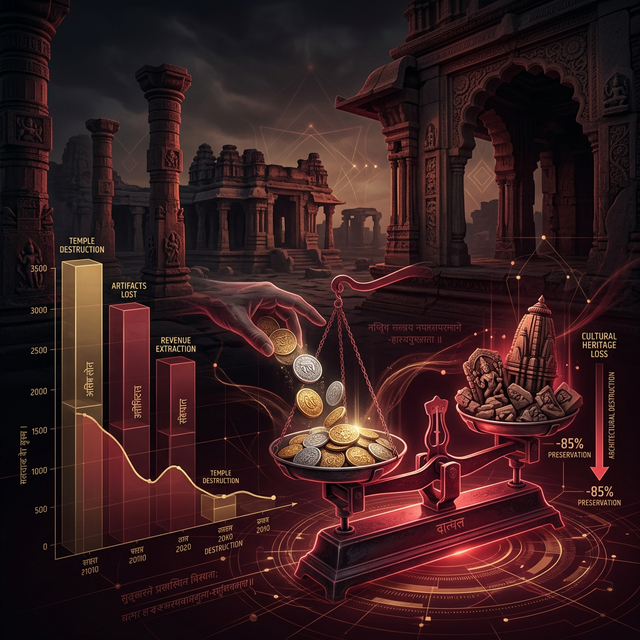
The Timur Massacre — A Statistical Horror
The most quantifiable single catastrophe linked to Khwaja Jahan's governance failure is Timur's 1398
Delhi massacre. Let us put these numbers in perspective:
- 1,00,000 Hindus massacred in Delhi in a single day — This is documented in
Timur's own memoirs. For context: the population of Delhi at the time is estimated at 3–5 lakh.
The massacre thus killed 20–33% of the city's entire population in one day.
- 50,000+ enslaved and marched on foot thousands of kilometers to Samarkand. The
death toll en route was enormous; historians estimate less than half survived the journey.
- 15 days of systematic looting of Delhi's temples, homes, markets, and treasury
after the city fell — described in multiple contemporary accounts as unprecedented even by
Sultanate standards.
- The post-invasion famine that Timur's destruction caused resulted in additional tens of
thousands of deaths from starvation in the Gangetic plains over the following
months.
"The whole city was sacked, plundered and destroyed. The mosques and the temples and other buildings
were all burned down... the town was reduced to ashes. At this time, a famine ensued in the
territory
of Hind and the people perished."
— Ferishta, Tarikh-i-Ferishta, on the aftermath of Timur's
1398 invasion
Wealth Extracted from India
The economic extraction from India during this period operated on multiple levels. While exact
figures are difficult to calculate, chronicles provide enough data for informed estimates:
₹
Timur's Loot from Delhi (1398)
Chronicles record Timur taking 120 war elephants loaded with treasure, thousands of gold
and silver vessels, and 90 captured war elephants. Historian Srinivasachari estimates
this at approximately 100–200 crore rupees in 1900 value — equivalent to tens of
thousands of crores today. All extracted from India by a force that Khwaja Jahan was
responsible for repelling.
Tuzk-i-Timuri; Ferishta
₹
Sayyid Tribute to Timurid Samarkand (1414–1451 CE)
All four Sayyid rulers paid annual tribute to the Timurid empire (Shah Rukh, then Ulugh
Beg). While exact figures are not preserved for each year, contemporary sources indicate
regular large-scale tribute in gold, silver, and goods — effectively funneling Indian
wealth out of the country for 37 years. This tribute was extracted from India's Hindu
taxable population through Jizya and kharaj.
Yahya Sirhindi; Shah Rukh's letters
₹
Temple Endowment Confiscations
Temple endowments (devasthanam land grants) in the Jaunpur and Gangetic belt were
immense. Converted to mosque income, they represented both the confiscation of existing
wealth and the redirection of future agricultural surplus away from Hindu communities
and Sanskrit education into Islamic institutions.
Regional revenue records; ASI documentation
The Long-Term Damage to India
Beyond the immediate numbers, the Khwaja Jahan–Sayyid era caused structural damage to Indian
civilization that compounded over generations:
- Population collapse: The combined effect of Timur's massacre, post-invasion
famine, Sayyid punitive campaigns, and forced displacement reduced the population of the
Gangetic plains by an estimated 20–30% over the 1394–1451 period.
- Agricultural devastation: The burning of crops and cattle during military
campaigns caused multi-year famines across affected regions. Land that had been under continuous
cultivation for centuries was abandoned.
- Knowledge system implosion: The destruction of Sanskrit learning centers during
this period accelerated a decline in India's indigenous scientific, mathematical, and
philosophical traditions. The "knowledge gap" created when these scholars were displaced took
centuries to partially bridge.
- Demographic transformation: Forced conversions, migration of Hindus from major
urban centers, and the settlement of Muslim populations in formerly Hindu towns permanently
altered the demographic character of the Jaunpur-Lucknow-eastern UP corridor — effects visible
to this day.
- Cultural memory erasure: The destruction of temple archives, oral tradition
repositories, and Sanskrit institutions severed communities from their cultural heritage. This
erasure of historical memory is itself a form of devastating, irreversible loss.