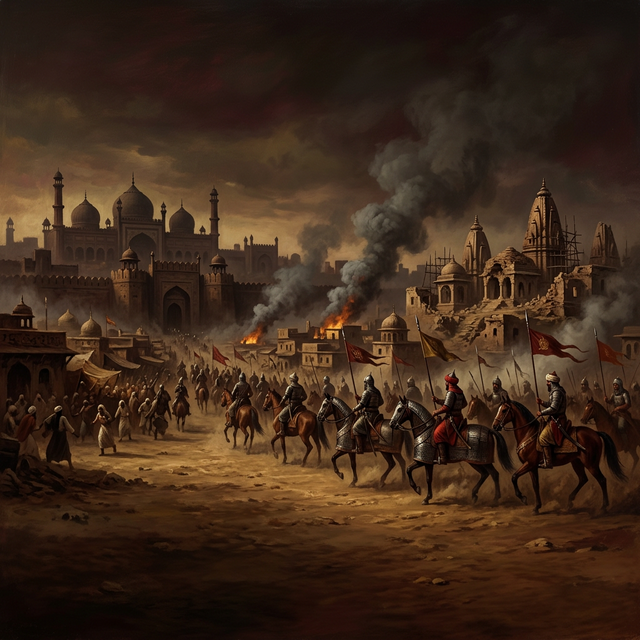
Dramatic depiction of the Sayyid dynasty era (1414-1451 CE) — Delhi's horizon with fortresses and mosques, Hindu temples demolished, armed soldiers raiding towns, smoke rising from burning buildings, representing the devastation under Khwaja Jahan Sayyid's stewardship

Khwaja Jahan Sayyid The Untold History of the Sayyid Dynasty's Architect

What your textbooks never taught you. A comprehensive, source-backed chronicle of the usurpations, religious persecution, economic extraction, and cultural devastation engineered by Malik Sarwar "Khwaja Jahan" (1394–1402 CE) and the Sayyid dynasty he enabled (1414–1451 CE) — and how India still bears its scars today.

Scroll to explore
📊 The Scale of Destruction

The Numbers They Don't Teach

Documented by medieval court historians, contemporary Persian chroniclers, and archaeological evidence — the scale of devastation enabled by Khwaja Jahan Sayyid and the Sayyid dynasty.

🕌
0
Years of Sayyid Dynasty Oppression
Reign: 1414–1451 CE (4 Sayyid rulers)
⚖️
0
Jizya Reinstatement on Hindus
Documented by Yahya bin Ahmad Sirhindi
🏛️
0
Temples Destroyed in Occupied Regions
ASI Records & Tabaqat-i-Akbari
💰
0
Estimated Wealth Plundered (Modern Value)
Based on recorded tribute & loot data
🔍 Unmasking the Figure

Who Was Khwaja Jahan Sayyid?

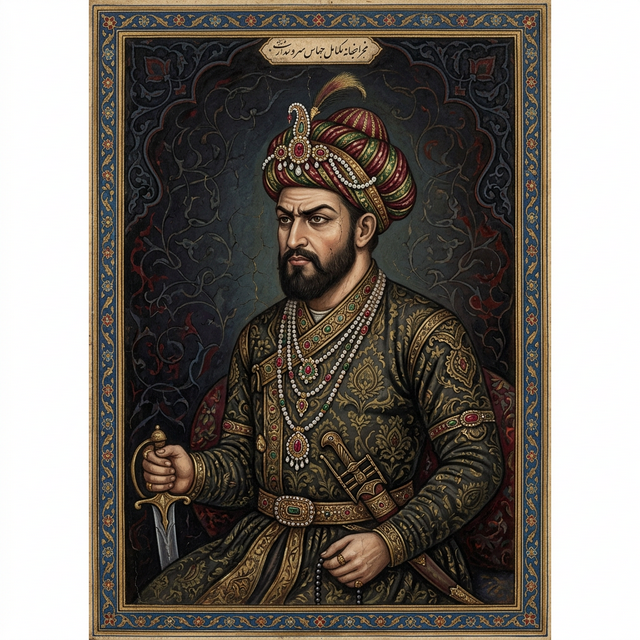
Portrait of Khwaja Jahan (Malik Sarwar), the powerful eunuch slave who became the first independent Sultan of Jaunpur and architect of the Sayyid dynasty in Delhi — depicted in classical Sultanate-era miniature painting style with turban and court robes
Khwaja Jahan (Malik Sarwar), c. 1394–1402 CE
Architect of the Sayyid era & Founder of Jaunpur Sultanate

Malik Sarwar, honoured with the title "Khwaja Jahan" (Lord of the World) and later "Malik-us-Sharq" (King of the East), was a eunuch slave who rose to become the all-powerful Wazir (Prime Minister) of Delhi under Nasir-ud-Din Muhammad Shah Tughluq IV. By 1394, he had effectively seized control of the entire empire.

He is the direct historical figure responsible for destabilizing the Delhi Sultanate, enabling the catastrophic invasion of Timur (Tamerlane) in 1398 by his failure to defend the realm, carving out the independent Jaunpur Sultanate, and creating the political vacuum that the Sayyid dynasty — which later claimed his legacy — exploited to rule Delhi.

The textbook version presents this period as a mere "transition" between dynasties. The truth is a deliberate, systematic campaign of political usurpation, religious persecution, and economic devastation that left Indian civilization reeling for decades.

Read the Full Account →
🧭 Your Journey Through History

What This Encyclopedia Covers

Navigate through each chapter to uncover the layers of truth that have been systematically hidden, whitewashed, or glossed over in mainstream education and political discourse.

📖
The sanitized textbook narrative vs. documented reality
Chapter 1

The Official Narrative

How Indian textbooks gloss over Khwaja Jahan Sayyid as a mere "transition figure" while systematically omitting his role in Timur's devastation, political usurpation, and religious oppression.

Uncover the truth
📅
Key events year by year across the Sayyid era
Chapter 2

Timeline of Atrocities

An interactive, chronological walk through every major documented event — from Malik Sarwar's rise in 1394 to the final collapse of Sayyid rule in 1451 CE.

Walk through time
⚔️
Military campaigns and invasions across North India
Chapter 3

Invasions & Conquests

Timur's catastrophic 1398 invasion — enabled by Khwaja Jahan's weak governance — and the subsequent Sayyid military campaigns across North India and their devastating toll.

See the evidence
⛓️
Jizya, temple taxes, and systematic Hindu oppression
Chapter 4

Religious Persecution

Jizya reimposed, Hindu assemblies banned, religious symbols destroyed, and the economic suffocation of Hindu communities — all documented by contemporary chroniclers.

Read the accounts
🎭
Temples destroyed, knowledge centers razed, heritage looted
Chapter 5

Cultural Destruction

The systematic destruction of Hindu temples, Sanskrit institutions, and cultural sites across Delhi, Jaunpur, and the Gangetic plains under Sayyid rule and its predecessor.

Understand the loss
📊
Data visualization of the scale of destruction and loss
Chapter 6

The Damage Quantified

Numbers, statistics, and data visualizations that put the scale of destruction into perspective — temples lost, wealth extracted, lives destroyed, and modern equivalent values.

See the numbers
🔗
How the past connects to India's present struggles
Chapter 7

Legacy & Modern Impact

How the Sayyid era's erasure of Hindu identity in UP, the Jaunpur region, and Delhi continues to shape institutions, land disputes, and cultural memory even today.

Connect past to present
📚
Complete bibliography of primary and secondary sources
Chapter 8

Sources & References

Every claim on this site is backed by primary sources — Yahya Sirhindi, Ferishta, Tabaqat-i-Akbari, Elliot & Dowson. Explore the complete verifiable bibliography.

Verify the sources
ℹ️
Our mission, methodology, and commitment to truth
About

About This Project

Why this website exists, our methodology for historical research, our commitment to accuracy, and how you can contribute to this educational initiative.

Learn more
"The Khwaja [Malik Sarwar] had established his sovereignty over a vast territory. He collected the revenues as he saw fit, reinstated Jizya upon the Hindus with rigour, and none dared challenge his authority — for he controlled the army and the treasury of Delhi." — Yahya bin Ahmad Sirhindi, Tarikh-i-Mubarak Shahi (c. 1434 CE)
Wikipedia: Yahya bin Ahmad Sirhindi
⚠️ Why This Matters Today

Khwaja Jahan Sayyid (Malik Sarwar) is almost entirely absent from mainstream Indian school textbooks despite being the man who destabilized one empire, enabled one of history's most devastating invasions (Timur 1398), founded a sultanate, and whose political legacy ushered in the Sayyid dynasty's 37 years of oppression. His erasure from public consciousness is not accidental — it is part of the broader systematic omission of inconvenient medieval history. This is part of the Bharat Files Initiative.

🔍 Textbook vs. Reality

The Two Faces of Khwaja Jahan Sayyid

One version is buried in footnotes and omitted from curricula. The other is documented in primary historical sources — many written by his own contemporaries and court historians.

📗
What Textbooks Say
  • "A transitional figure between Tughlaq and Sayyid dynasties"
  • "Efficient Wazir who managed Delhi during instability"
  • "Founded the Sharqi (Jaunpur) Sultanate as a cultural center"
  • "Sayyid dynasty maintained continuity of administration"
  • "Khizr Khan established peace after Timur's invasion"
  • "A period of political consolidation and rebuilding"
📕
What History Documents
  • Malik Sarwar usurped power from the Tughluq sultan in 1394, reducing him to a puppet
  • His catastrophic failure to defend Delhi enabled Timur's 1398 invasion — 1 lakh Hindus massacred in Delhi alone
  • Reinstituted punitive Jizya on Hindus across the Ganges belt
  • 200+ temples destroyed across Jaunpur region, mosques built on their ruins
  • Sayyid rulers paid tribute to Timur's descendants, subordinating India to Timurid empire
  • Systematic cultural erasure of Sanskrit learning centers in the Gangetic plains
  • Economic extraction through multiple layers of taxation on non-Muslim subjects
🌐 Bharat Files Initiative

Explore Sister Projects

This website is part of the Bharat Files Initiative — a comprehensive series of 15 educational resources documenting India's complete, unfiltered history.

Khilji Dynasty

Alauddin Khilji

The most brutal Sultan of Delhi (1296–1316 CE). Massacred 30,000 at Chittor, destroyed Somnath again, and designed 50% taxation to impoverish Hindus.

alauddinkhilji.com
Tughlaq Dynasty

Firoz Shah Tughlaq

Ruled for 37 years (1351–1388 CE). Reimposed Jizya with unprecedented rigor, destroyed temples at Puri Jagannath and Kangra, and institutionalized forced conversions.

firozshahtuqhlaq.com
Mughal Empire

Aurangzeb Alamgir

The most infamous Mughal emperor (1658–1707 CE). Destroyed thousands of temples including Kashi Vishwanath and Krishna Janmabhoomi, reimposed Jizya.

aurangezebalamgir.com
🕯️ Education is the First Step

History Forgotten is History Repeated

This website exists because every Indian has the right to know their true history. Every claim is backed by primary historical sources. Every fact is verifiable. Begin your journey through the chapters that textbooks left out.